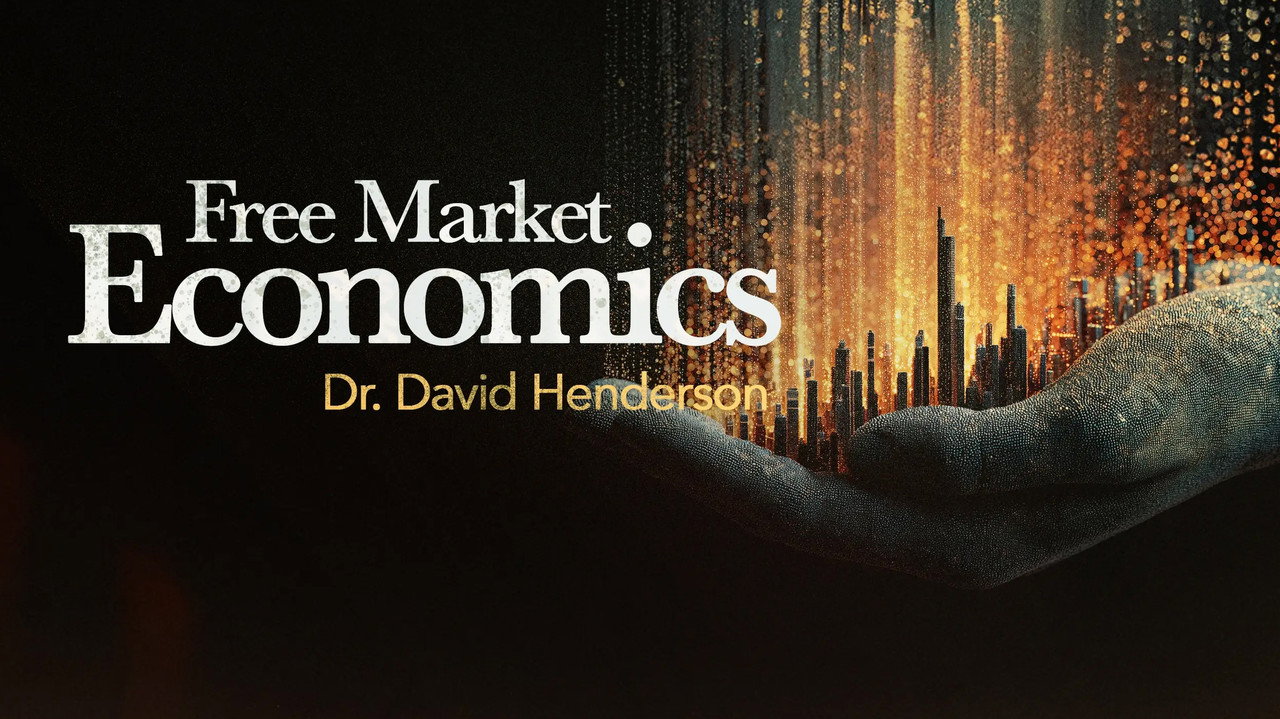
Free Market Economics
In Free Market Economics, Dr. David Henderson guides us through ten foundational pillars of economic wisdom and the major schools of thought—Austrian, Chicago, UCLA, and Public Choice. Along the way, we explore how markets coordinate through decentralized knowledge, property rights, and voluntary exchange, and why central planning so often falls short. Drawing on vivid historical cases—from the Soviet economic collapse to West Germany’s postwar miracle—the course brings core ideas like subjective value, spontaneous order, and entrepreneurial discovery to life. Ultimately, it shows how economic freedom and open inquiry fuel innovation and prosperity, while government intervention frequently produces unintended consequences and inefficiencies.
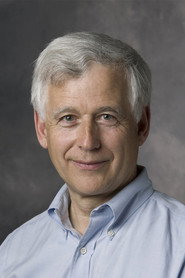
Cast: Dr. David Henderson
Course 1
10 episodes
- 1. Pillars of Economic Wisdom: Part 1In our introductory lecture, we explore the foundations of free market economics through the first five pillars of economic wisdom and how different schools of thought explain market dynamics. We examine TANSTAAFL (“there ain’t no such thing as a free lunch”), incentives, marginal thinking, wealth creation through higher-valued resource use, and the role of decentralized information in market efficiency. Using examples from Soviet economic failures to modern market exchanges, Dr. Henderson shows how these principles explain both the success of free markets and the shortcomings of centrally planned economies.CC45minMay 22, 2026
- 2. Pillars of Economic Wisdom: Part 2In lecture two, we continue with pillars six through ten of economic wisdom, beginning with the idea that every action has unintended consequences, illustrated by examples like Britain’s rat bounty system and safety in the shipping industry. We also examine subjective value and voluntary exchange, the difference between creating jobs and creating wealth, and why real income grows only through increased output. The lecture concludes by demonstrating that competition is a "hardy weed" rather than a delicate flower, naturally emerging unless government intervention creates monopolies, as evidenced by successful deregulation in trucking and airlines that dramatically lowered prices and increased consumer choice.CC39minMay 22, 2026
- 3. Austrian School: Part 1In lecture three, we study the Austrian School of Economics through the work of Carl Menger and Eugen von Böhm-Bawerk, key figures in the marginal revolution of 1871 that challenged the labor theory of value. We examine how they introduced the idea that value is subjective and that each additional unit of a good becomes less valuable, resolving puzzles like Adam Smith’s diamond-water paradox and showing that labor does not determine value. The lecture also covers Menger’s insights on money and price formation, along with Böhm-Bawerk’s theories of capital and interest rates, laying the foundation for modern subjective value theory and market dynamics.CC36minMay 29, 2026
- 4. Austrian School: Part 2In lecture four, we continue our study of the Austrian School of Economics through the work of Ludwig von Mises, Friedrich Hayek, and Israel Kirzner, focusing on economic calculation under socialism. We examine Mises’s argument that socialism cannot allocate resources rationally without market prices, Hayek’s explanation of how prices coordinate dispersed knowledge through spontaneous order, and Kirzner’s emphasis on entrepreneurial alertness and competition as a discovery process. The lecture concludes by highlighting how these Austrian economists demonstrated that markets succeed not through central planning but through the decentralized use of knowledge that no single authority could possess or coordinate.CC56minMay 22, 2026
- 5. Chicago SchoolIn lecture five, we learn about the Chicago School of Economics through the contributions of Frank Knight, Milton Friedman, George Stigler, Gary Becker, Ronald Coase, and Sam Peltzman. We examine Knight’s distinction between risk and uncertainty, Friedman’s work on monetary theory and the military draft, Stigler’s research on minimum wages and regulation, and Becker’s analysis of discrimination economics. The lecture concludes with Coase’s work on externalities and property rights and Peltzman’s research on regulation, highlighting how the Chicago School transformed economics through empirical analysis rather than abstract theory.CC1 h 1 minMay 22, 2026
- 6. Mainstream EconomicsIn lecture six, we consider the work of mainstream economists outside the Austrian, Chicago, and UCLA Schools who contributed to free market economics and critiques of government regulation. We examine Robert Crandall’s work on pollution trading, Clifford Winston’s deregulation studies, Edward Glaeser’s housing research, Martin Feldstein’s tax analysis, Douglas Irwin’s trade work, Jagdish Bhagwati’s free trade principles, David Neumark’s minimum wage studies, and Michael Clemens’s immigration research. The lecture concludes with Thomas Sowell’s work on data analysis, wealth mobility, and individual choice, showing how economic research across diverse institutions highlights the benefits of free markets and the costs of government intervention.CC49minMay 22, 2026
- 7. UCLA SchoolIn lecture seven, we explore the UCLA School of economic thought, focusing on the foundational work of Armen Alchian and Harold Demsetz, along with contributions from Jack Hirshleifer and Benjamin Klein. We examine property rights theory, the economics of discrimination, the role of residual claimants in organizations, and how strong property rights address social and economic problems. The lecture concludes with Demsetz’s critique of the “nirvana approach” to policy analysis and Klein’s insights into advertising as a signal of quality, showing how UCLA economists challenged conventional thinking across economic theory.CC53minMay 22, 2026
- 8. The Hockey StickIn lecture eight, we go over Joel Mokyr’s Nobel Prize-winning analysis of the Industrial Revolution and the “hockey stick” pattern of economic growth that transformed human living standards after centuries of stagnation. We analyze how Britain's Industrial Revolution was fueled by the combination of propositional knowledge (why things work) and prescriptive knowledge (how things work), together with the freedoms of trade, labor mobility, and intellectual exchange. Dr. Henderson contrasts Britain’s openness with historical examples of isolation, such as China, and concludes by emphasizing that freedom of inquiry and international openness remain essential for continued innovation and prosperity.CC32minMay 22, 2026
- 9. Public Choice SchoolIn lecture nine, Dr. Henderson explains the public choice school of economics, which applies economic analysis to political behavior and shows how self-interest influences politicians, bureaucrats, and voters. We discuss the median voter theorem, the problem of concentrated benefits and dispersed costs (e.g., sugar import quotas), and the ideas of rational ignorance and rational irrationality among voters. The lecture concludes by examining how public choice theory supports constitutional constraints like separation of powers and checks and balances, while noting that these limits are often imperfectly enforced in practice.CC29minMay 22, 2026
- 10. The West German Economic MiracleIn our tenth and final lecture, we explore the West German economic miracle after World War II, showing how free market ideas transformed a devastated economy into one of the world’s most prosperous. We examine how postwar price controls and rationing led to inefficiency and barter until reforms led by Ludwig Erhard introduced currency reform and removed price controls in 1948. The lecture concludes with the rapid surge in industrial production and sustained growth that followed, and Dr. Henderson illustrates how ideas and economic policies matter more than financial assistance.CC23minMay 22, 2026
Viewers also watched


Free Market Economics
In Free Market Economics, Dr. David Henderson guides us through ten foundational pillars of economic wisdom and the major schools of thought—Austrian, Chicago, UCLA, and Public Choice. Along the way, we explore how markets coordinate through decentralized knowledge, property rights, and voluntary exchange, and why central planning so often falls short. Drawing on vivid historical cases—from the Soviet economic collapse to West Germany’s postwar miracle—the course brings core ideas like subjective value, spontaneous order, and entrepreneurial discovery to life. Ultimately, it shows how economic freedom and open inquiry fuel innovation and prosperity, while government intervention frequently produces unintended consequences and inefficiencies.
Creators and cast
- Created by
- Dr. David Henderson
- Studio
- Peterson Academy
Maturity rating
Not yet rated.
Audio languages
English
Where to watch
Not currently listed on any streaming, rental or purchase service.