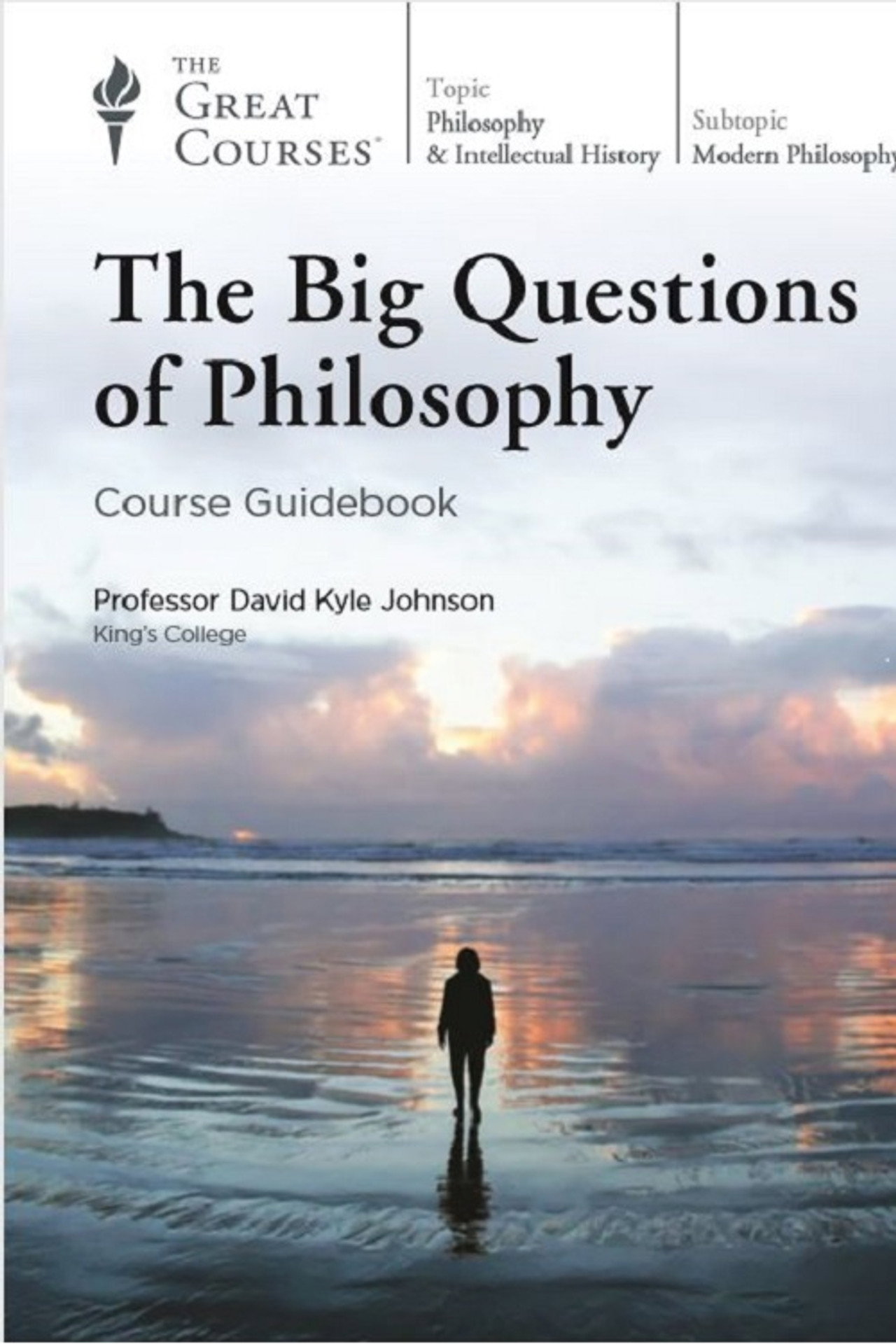
Big Questions of Philosophy
We have all pondered seemingly unanswerably but significant questions about our existence—the biggest of all being, “Why are we here?” Philosophy has developed over millennia to help us grapple with these essential intangibles. There is no better way to study the big questions in philosophy than to compare how the world’s greatest minds have analyzed these questions, defined the terms, and then reasoned out potential solutions. Once you’ve compared the arguments, the final step is always deciding for yourself whether you find an explanation convincing.
Season 1
36 episodes
- 1. How Do We Do Philosophy?The first four lectures of the course pose the big question: What is philosophy? Start by exploring the kinds of problems that philosophy addresses, the way philosophy works, and the distinction between philosophy and opinion. Discover that philosophy is arguably the most important pursuit there is.CCJul 2, 2018
- 2. Why Should We Trust Reason?Hone your philosophical thinking by identifying the categories of fallacious reasoning that ensnare us all. Investigate examples of gut-thinking, confirmation bias, appealing to ignorance, the correlation fallacy, begging the question, and equivocation. Learn how to check your reasoning for flaws.CCJul 9, 2018
- 3. How Do We Reason Carefully?Avoiding fallacious reasoning is just the beginning of philosophical thinking. Go deeper by studying the rules of deduction and induction. In the process, learn Aristotle's three axioms of logic, the difference between truth and validity, common mistakes in logical arguments, and why practically all scientific arguments are inductive.CCJul 16, 2018
- 4. How Do We Find the Best Explanation?Explore the power of abduction, a form of induction also known as inference to the best explanation, that is used not only by philosophers, but also by doctors to make medical diagnoses and scientists to construct theories. Even Sherlock Holmes - the master of deduction - really practiced abductive inference.CCJul 23, 2018
- 5. What Is Truth?Now begin a section of the course devoted to the big question: What is knowledge? Start with the problem of defining truth. Investigate three philosophical theories that attempt to pin down this elusive concept: pragmatism, coherentism, and the correspondence theory.CCJul 30, 2018
- 6. Is Knowledge Possible?Having covered ways of gaining evidence and justifying belief in pursuit of knowledge, now ask: Is knowledge really possible? See what Plato had to say. Then delve into Rene Descartes' celebrated struggle with this problem, analyzing the strengths and weaknesses of his position.CCAug 6, 2018
- 7. What Is the Best Way to Gain Knowledge?Put empiricism to the test as the best way to acquire knowledge. Study the ideas of John Locke, George Berkeley, and David Hume, together with the response of Immanuel Kant, before settling on the most effective route to understanding the world as it is.CCAug 13, 2018
- 8. Do We Know What Knowledge Is?Address a famous problem concerning the nature of knowledge, posed by contemporary philosopher Edmund Gettier. Use different thought experiments to test the traditional definition of knowledge. Discover firsthand the bafflement and enlightenment that comes from doing philosophy.CCAug 20, 2018
- 9. When Can We Trust Testimony?In this section, put what you've learned to work by asking the big question: Can religious belief be justified? Start with Hume's argument that testimony can never justify a belief that a miracle has occurred. Analyze the flaws in Hume's reasoning, and think about whether his conclusion still holds.CCAug 27, 2018
- 10. Can Mystical Experience Justify Belief?Look at the phenomenon of religious experiences, pondering whether such events justify belief. Find that practically all religions have religious experiences, but the beliefs they lead to can be radically different. Can feeling the touch of God," like Jules in Pulp Fiction, justify religious belief? "CCSep 3, 2018
- 11. Is Faith Ever Rational?Given that faith by its nature makes no claim to being logical, can it ever be considered rational? Learn that all of us unconsciously behave as if it is. What are our grounds for doing so, and how does this apply to religious faith? Your inquiry introduces you to famous arguments by Blaise Pascal, William Clifford and William James.CCSep 10, 2018
- 12. Why Is There Something Rather Than Nothing?Begin a series of lectures addressing the next big question: Does God exist? The most popular proofs appeal to God's existence as the best explanation for the universe's existence and nature. In this lecture, test the cosmological and teleological arguments, using the tools of philosophy and the evidence of physics.CCSep 17, 2018
- 13. What Is God Like?Traditionally, if God exists, God is perfect - God is omniscient, omnipotent and omnibenevolent. See how these three attributes are likely inconsistent with each another. Focus in particular on the difficulties with St. Anselm's argument for a perfect God, and look at modern proposals for redefining our conception of God.CCSep 24, 2018
- 14. How Could God Allow Moral Evil?Now consider arguments against God's existence, the most common being the problem of evil. Explore various theological solutions that account for why God allows certain evils, like the holocaust. Does God have reasons we cannot understand? Examine the flaws in this argument.CCOct 1, 2018
- 15. Why Would God Cause Natural Evil?It is one thing for God to grant humans the freedom to do evil, but it's harder to understand the existence of natural evils such as earthquakes and plagues. Evaluate different approaches to this problem, including the suggestion that God exists but didn't create our universe.CCOct 8, 2018
- 16. Are Freedom and Foreknowledge Compatible?Do we have free will? This is your next big question. Begin with a close study of omnitemporalism - the idea that the future already exists and that God necessarily has foreknowledge of it. Taking this view, attempt to make sense of the notion that people have the power to act freely.CCOct 15, 2018
- 17. Do Our Souls Make Us Free?Look at the problem of free will from the point of view of the soul, the conjectured seat of mentality that exists apart from the body. Discover that neuroscience suggests that the soul does not exist and also casts doubt on the concept of free will.CCOct 22, 2018
- 18. What Does It Mean to Be Free?Some philosophers, called compatibilists, argue that if we understand free will correctly, the idea that humans are free becomes defensible, leaving room for moral responsibility. Evaluate this stance, and close by considering the consequences of conceding that we don't have free will in the traditional sense.CCOct 29, 2018
- 19. What Preserves Personal Identity?Spend the next four lectures on the big question: Could there be an afterlife? First, ask what defines a person and how personal identity is preserved over time. Discover that many proposed answers fail, including the notion that personal identity is preserved by the soul.CCNov 5, 2018
- 20. Are Persons Mere Minds?Explore the possibility that personal identity is preserved by memory, as Locke contended, or by psychological continuity. Test these ideas in thought experiments involving the transporter from Star Trek and other intriguing scenarios.CCNov 12, 2018
- 21. Are Persons Just Bodies?Could it be that you are the same person over time because you have the same body over time? Explore the implications of this view, which traces to the Judeo-Christian concept of the resurrection of the body in the afterlife. Consider biological objections.CCNov 19, 2018
- 22. Are You Really You?Close your inquiry into the afterlife by looking at new ways of defining personhood. According to perdurantism, a person is the sum total of an individual's life experiences and cannot be isolated to a particular time and place. Then question the very concept of a person - a move that may rule out the possibility of an afterlife.CCNov 26, 2018
- 23. How Does the Brain Produce the Mind?The next three lectures address the big question: What is the nature of the mind? Start with the celebrated "hard problem" of consciousness: How does the brain produce the mind? Investigate two possible answers and explore why many philosophers consider both to be problematic.CCDec 3, 2018
- 24. What Do Minds Do, If Anything?Examine three more theories of the mind - property dualism, epiphenomenalism, and eliminative materialism - discovering that each has shortcomings. All of us feel that we have minds, so why is it so difficult to pin down what the mind is? Could the mind be an illusion?CCDec 10, 2018
- 25. Could Machines Think?Push your exploration of the mind even further by looking at functionalism, which suggests that anything that functions like our brain has mentality. The implication is that, in principle, machines can think. Study some responses to this theory, including John Searle's thought experiment called the Chinese Room.CCDec 17, 2018
- 26. Does God Define the Good?Turn to the next big question: What is morally right and wrong? Your first step is to inquire what establishes the truth of ethical statements. Look briefly at emotivism, which holds that our emotions tell us what is right. Then focus on divine command theory, which considers God to be the source of moral truth.CCDec 24, 2018
- 27. Does Happiness Define the Good?Could the happiness or absence of pain that results from an action define whether it is good? The Greek philosopher Epicurus held this view, which was fine-tuned by utilitarian philosophers Jeremy Bentham and John Stuart Mill. Study objections to this outlook.CCDec 31, 2018
- 28. Does Reason Define the Good?Kant suggested that reason determines what is moral or immoral. Analyze his famous categorical imperative, which is a set of obligatory moral rules guided by reason. See how Kant's rules go far beyond the Golden Rule. Then uncover the shortcomings of the categorical imperative.CCJan 7, 2019
- 29. How Ought We to Live?Take up virtue ethics, which suggests that we should concentrate less on resolving which actions are moral or immoral, and instead focus on cultivating virtue. Explore the complexities of this quest, the need to use practical wisdom, and its ultimate goal of eudaimonia, or well-being.CCJan 14, 2019
- 30. Why Bother Being Good?Wickedness has its rewards, which raises the question: Why bother being good? Explore this issue with Plato, whose dialogue The Republic is a detailed description of a highly regulated, virtuous society. Plato contends that the individual achieves virtue in an analogous way.CCJan 21, 2019
- 31. Should Government Exist?This section of the course considers the big question: How should society be organized? Here, perform a thought experiment that casts into doubt the moral justification of government. Then probe more deeply into this view, called philosophical anarchism, which has a spectrum of positions from benign to violent.CCJan 28, 2019
- 32. What Justifies a Government?Does government arise naturally from a state of anarchy? Does this fact morally justify it? Thomas Hobbes, John Locke, and Jean Jacques Rousseau thought so. However, each of these philosophers saw different factors driving individuals to enter into the social contract. Compare their views.CCFeb 4, 2019
- 33. How Big Should Government Be?Explore three theories on the proper size of government, focusing on economic regulation and delivery of services. Adam Smith saw a minimal role, Karl Marx envisioned total control, and John Maynard Keynes believed that major government intervention was necessary under certain conditions.CCFeb 11, 2019
- 34. What Are the Limits of Liberty?Deepen your study of the role of government by examining Mill's arguments in his famous 1859 treatise, On Liberty. Apply his reasoning to three of today's hot-button issues: To what extent should marijuana, gay marriage, and offensive and inflammatory speech be legal?CCFeb 18, 2019
- 35. What Makes a Society Fair or Just?Enter the fray with philosophers John Rawls and Robert Nozick, who reached different conclusions about what would constitute a just society. Begin with a thought experiment based on Christopher Nolan's movie Interstellar, pondering how you might start civilization from scratch in the fairest possible way.CCFeb 25, 2019
- 36. What Is the Meaning of Life?Professor Johnson poses the last big question of the course: Can we answer the ultimate question? Draw on the many insights you've gained from these lectures, together with your experience thinking philosophically, to probe the meaning of life from several points of view.CCMar 4, 2019
Big Questions of Philosophy
We have all pondered seemingly unanswerably but significant questions about our existence—the biggest of all being, “Why are we here?” Philosophy has developed over millennia to help us grapple with these essential intangibles. There is no better way to study the big questions in philosophy than to compare how the world’s greatest minds have analyzed these questions, defined the terms, and then reasoned out potential solutions. Once you’ve compared the arguments, the final step is always deciding for yourself whether you find an explanation convincing.
Maturity rating
Not yet rated.
Where to watch
Stream


Buy
